 Euler finance
 connects lending vaults so users can supply assets or borrow against accepted collateral
Euler finance lets users lend through configurable vaults or borrow assets against collateral that the chosen lending market accepts. Its modular design gives individual vaults their own lending rules, risk settings and borrowing limits. Supplying creates a claim on vault assets; borrowing creates debt that accrues interest. Choosing a position therefore means choosing specific collateral relationships and liquidity conditions. EulerEarn adds managed allocation across strategies, while Multiply supports leveraged positions where a suitable route exists.
- last updated
In short: Each Euler lending market sets its own collateral requirements, so borrowing capacity and supplier exposure depend on the vaults involved.
Lending vaults and collateral connections serve different jobs
A lending vault holds one underlying asset, and its suppliers receive shares representing their claim on that vault. A borrowing market connects a debt vault with the collateral vaults that it accepts. These relationships determine which deposits can support a particular loan.
The Euler Vault Kit, or EVK, provides the contracts for configurable lending vaults. These extend ERC-4626, a tokenized vault standard, with borrowing functionality. The Ethereum Vault Connector, or EVC, coordinates collateral permissions and actions involving several vaults. It also supports separate accounts for distinct positions.
Direct lending selects a particular vault. EulerEarn holds one deposit position while configured managers allocate its asset among enabled strategies.
That distinction changes what a supplier evaluates. Direct lending exposes the deposit to the selected vault's borrowers and collateral arrangements. An Earn position also depends on its strategy selection, allocation permissions and withdrawal queue. Its accounting balance can exceed the amount immediately available to withdraw. Both approaches require attention to the underlying exposures; holding one share position doesn't remove them.
A supply-only decision before taking on debt
In this hypothetical example, you hold an asset accepted by a selected lending vault and want to earn lending income without owing another asset. Assume the wallet has enough network gas, the deposit fits the current supply cap and the vault permits your deposit. These are example conditions, not claims about an available market.
The two relevant options are a direct supply position and a collateral-backed borrowing position. Both involve depositing assets, but only the latter creates borrowing debt. You compare the debt each option would leave you owing. A quoted yield or generous borrowing limit doesn't change your requirement to avoid debt.
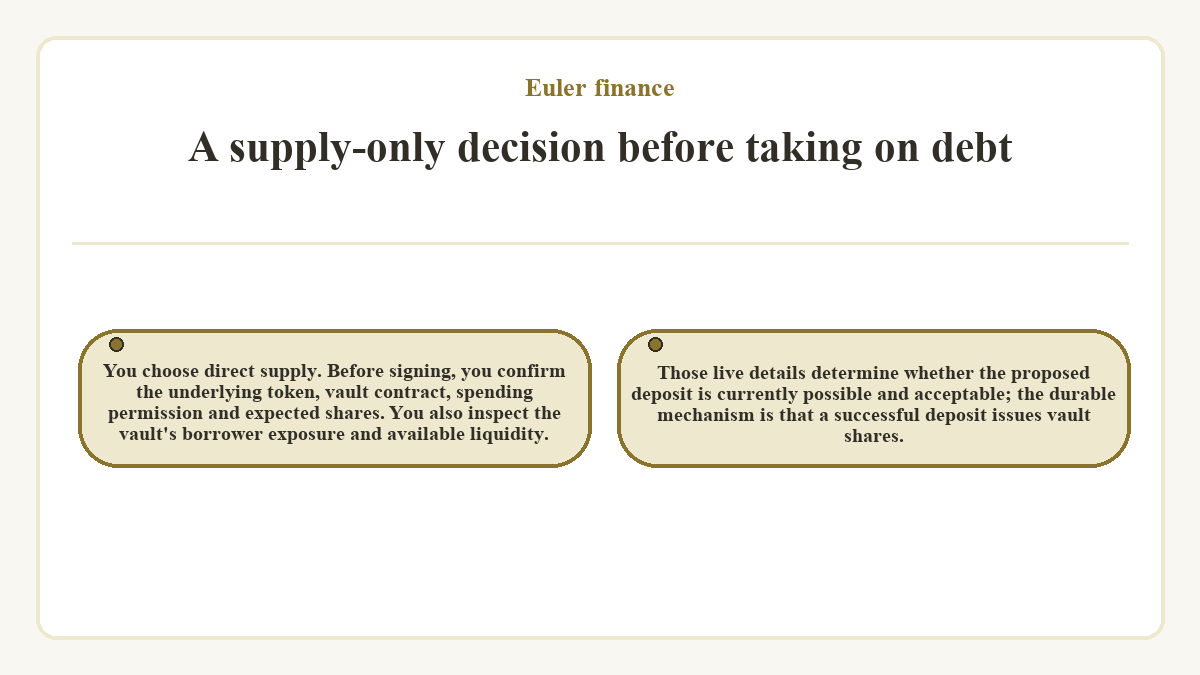
You choose direct supply. Before signing, you confirm the underlying token, vault contract, spending permission and expected shares. You also inspect the vault's borrower exposure and available liquidity. Those live details determine whether the proposed deposit is currently possible and acceptable; the durable mechanism is that a successful deposit issues vault shares.
After the deposit transaction confirms, the account shows vault shares representing the supplied balance, with no new borrowing debt. The deposit still carries the risk of lending losses and remains subject to withdrawal constraints. A later change in the displayed yield doesn't turn this position into a fixed-return product.
Rates and limits belong to the selected market
Borrowing capacity depends on accepted collateral, its valuation, the borrow loan-to-value limit and available lending liquidity. A borrow cap can restrict the amount further. Loan-to-value, usually shortened to LTV, relates debt value to collateral value. Meeting a collateral requirement doesn't create liquidity that the debt vault lacks.
Interest follows the vault's configured interest-rate model. Many models respond to utilization, meaning the share of supplied liquidity that borrowers are using. Other models use different inputs, including time. Borrower interest contributes to supplier returns, with configured interest fees affecting the amount retained for suppliers. A displayed annual percentage yield expresses conditions over an annualized period; it isn't a locked payout. Compare the rate model, vault fee and any reward component separately, then account for transaction costs when assessing a position.
When can a borrowing position become liquidatable?
A borrowing position becomes eligible for liquidation when it fails the debt vault's applicable collateral requirements. Collateral prices can fall, the borrowed asset can rise in value and accrued interest can increase debt. The vault's configured oracle supplies the valuations used by its checks. A price shown elsewhere doesn't necessarily match that valuation.
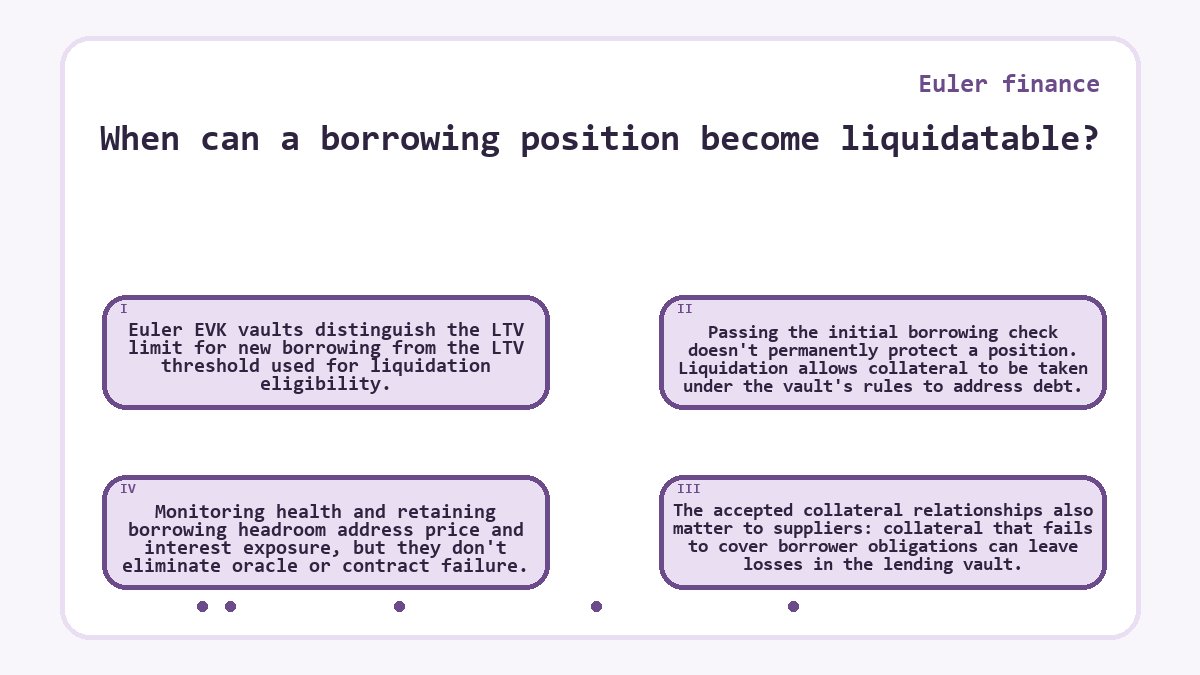
Euler EVK vaults distinguish the LTV limit for new borrowing from the LTV threshold used for liquidation eligibility. Passing the initial borrowing check doesn't permanently protect a position. Liquidation allows collateral to be taken under the vault's rules to address debt. The accepted collateral relationships also matter to suppliers: collateral that fails to cover borrower obligations can leave losses in the lending vault. Monitoring health and retaining borrowing headroom address price and interest exposure, but they don't eliminate oracle or contract failure.
Repayment and withdrawal have separate constraints
Repayment reduces borrowing debt, while withdrawal exchanges vault shares for underlying assets. A borrower may need to reduce debt before removing collateral because the remaining position must pass its health checks. Withdrawing collateral as underlying assets also requires enough liquidity in the relevant vault.
Debt includes accrued interest, so an earlier balance may no longer cover full repayment. Supported repayment flows can use wallet assets, deposits or collateral, with additional conditions when a swap is involved. Repaying everything removes that debt obligation; it doesn't guarantee immediate withdrawal of every supplied asset. Lending liquidity can remain committed to other borrowers. A rejected withdrawal should prompt inspection of available liquidity, remaining debt and the transaction's specific failure, rather than an assumption that the deposit has disappeared.
Multiply adds exposure through borrowing and swapping
Multiply builds a larger collateral position by borrowing an asset, swapping it for additional collateral and supplying that collateral back into the position. Where supported, the application prepares these actions together. Token approvals or permits may still require separate authorization.
The additional collateral comes with additional debt. Performance therefore depends on collateral returns, borrowing costs and the relative prices of both assets. Swap price impact and slippage also affect execution, especially when the borrowed amount exceeds the initial contribution. A displayed return estimate doesn't include every possible cost or establish future profitability. This route fits a deliberate choice to increase exposure; it adds obligations that aren't present in a supply-only deposit. Availability depends on the particular pair and executable swap route.
Market configuration determines the final choice
Permissionless vault creation lets curators configure lending arrangements for different assets and collateral relationships. That flexibility also means two markets can have different governance powers, oracle dependencies and operating restrictions. Their shared use of Euler contracts doesn't make their risks identical.
Builders can integrate vault actions through the EVC, while market operators choose collateral connections and supported parameters. A supplier or borrower needs the resulting configuration, rather than every deployment detail, to understand the position. The addresses with authority to change that configuration remain relevant throughout its life.
Core contract reviews address implementation risks. Individual market settings introduce further dependencies that those reviews don't settle.
Audits and formal verification apply to defined components and properties. A position also depends on deployed contracts, collateral links, oracle behavior and governance changes. Before committing to direct lending, managed allocation or borrowing, assess the exact vault configuration for that action. If immediate access to the entire deposit is essential, uncertain withdrawal liquidity is a material mismatch.
Popular questions about Euler finance
Can someone else repay my Euler borrowing debt?
Another account can fund repayment of an EVK borrowing debt. The repayment identifies the account whose debt should decrease, while the payer supplies the borrowed asset and the necessary spending allowance. This doesn't require transferring ownership of the borrowing position. Application support for that arrangement can differ from the underlying contract capability.
Does every Euler vault allow users to borrow its deposits?
Some Euler vaults are non-borrowable, so their deposited assets aren't available for borrowing from that vault. Their shares can still function as collateral where another vault accepts them. The distinction matters when choosing a deposit: being usable as collateral doesn't establish that the vault itself generates lending income from borrowers.
Is an Euler vault automatically open to every wallet?
A particular vault can impose access restrictions even though the protocol permits anyone to create vaults. Configured hooks can check or block selected operations, including deposits and borrowing. Eligibility therefore belongs to the specific deployment and action. Having the required asset or enough collateral doesn't override an access condition enforced by that vault.
Which amount does redeeming vault shares specify?
Redeeming specifies the number of shares to exchange, while withdrawing specifies the amount of underlying assets requested. The vault's share-to-asset conversion connects those amounts. Neither operation bypasses available liquidity, permissions or collateral health requirements. This distinction matters when an integration asks for shares and the user has calculated an amount in underlying tokens.
How are separate borrowing positions kept apart?
The EVC supports sub-accounts that can hold distinct borrowing positions under the same owner. EVK borrowing accounts use a single liability controller, so positions involving different debt vaults require separate accounts. Don't send underlying tokens directly to an unsigned derived sub-account unless the receiving flow explicitly supports EVC ownership. Ordinary ERC-20 contracts generally can't authenticate that ownership, so the owner's normal wallet signature generally can't recover those tokens.
What happens if I transfer shares that secure a loan?
Transferring collateral shares must leave the borrowing position valid. Shares that support an outstanding loan aren't freely removable when doing so would breach the account's collateral requirements. The permitted transfer therefore depends on the remaining collateral and debt after the action. A share balance alone doesn't establish how much can leave the account.