 Euler finance
 builds Multiply positions through borrowing and swaps that affect entry and exit costs
Euler finance uses Multiply to borrow a debt asset, exchange it for collateral and supply that collateral into a leveraged position. Where a supported route exists, this combines the position-building actions into a batch. Position size therefore affects both borrowing requirements and swap execution. Planning the trade means accounting for entry costs and the possible cost of selling collateral to repay debt.
- last updated
A multiplier alone doesn't describe an executable position. The selected pair needs sufficient liquidity, an acceptable swap quote and compatible borrowing limits. The amount left after an eventual unwind also depends on how the debt is funded.
Borrow and Multiply create different uses for borrowed assets
When the intended use is additional collateral exposure, Multiply prepares the borrowing, exchange and supply operations together. Ordinary borrowing serves a different purpose: it creates debt against accepted collateral without requiring that the borrowed assets become more collateral through this flow.
The distinction changes which costs belong in the plan. A Multiply entry involves the exchange needed for the chosen exposure. Increasing that exposure can require another exchange, while supplying additional collateral directly is a separate management action. Choosing the action starts with the intended balance change.
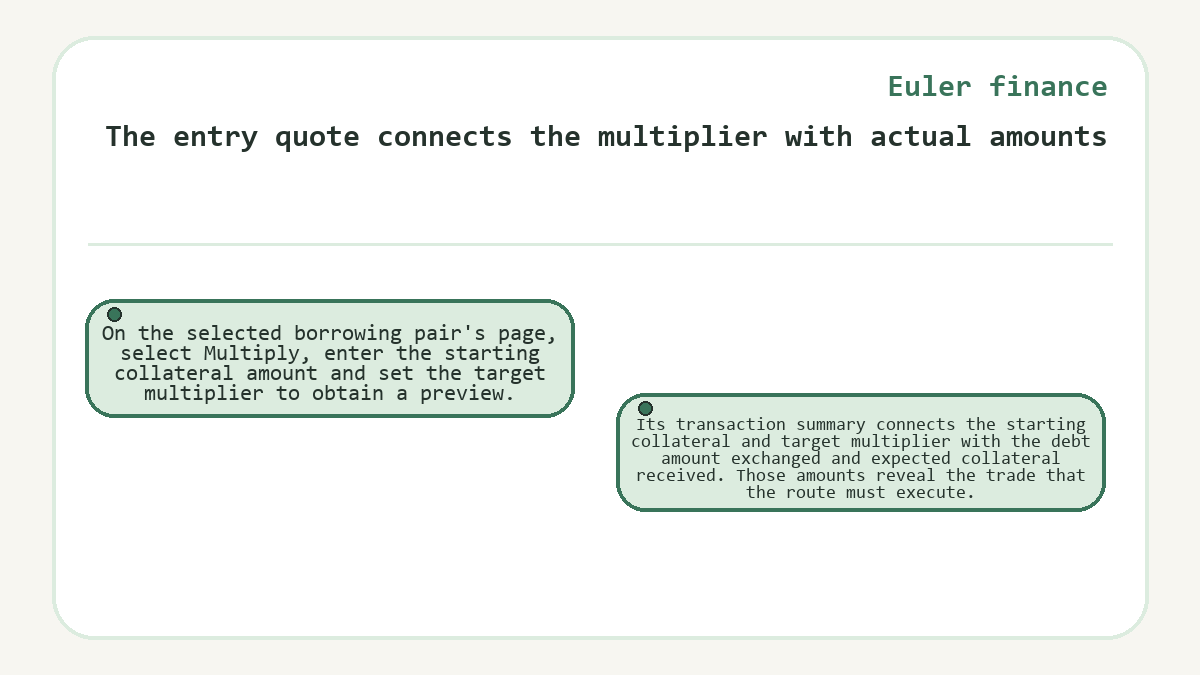
The entry quote connects the multiplier with actual amounts
On the selected borrowing pair's page, select Multiply, enter the starting collateral amount and set the target multiplier to obtain a preview. Its transaction summary connects the starting collateral and target multiplier with the debt amount exchanged and expected collateral received. Those amounts reveal the trade that the route must execute.
Before signing, review the route, price impact, slippage tolerance, estimated gas, token approvals and resulting position health. If the preview shows unacceptable execution costs or fails the borrowing checks, reduce the proposed multiplier and refresh the quote without submitting. Proceed only if the revised amounts and minimum output are acceptable and the resulting position passes its health checks. After execution, Portfolio lists the position under Positions. Its collateral and debt balances describe the position actually opened; the earlier quote describes the proposed transaction. Compare the confirmed collateral and debt balances with the reviewed amounts, allowing for the permitted swap variation.
Slippage tolerance limits deterioration after the quote
A quote can become less favorable before execution. Slippage tolerance determines how much adverse movement the transaction permits relative to that quote.
A Multiply swap should revert if execution would return less than its permitted minimum output. That boundary protects the transaction's execution terms. It doesn't promise that the original quote was economical or that the resulting position will remain healthy.
Price impact and slippage tolerance describe different effects. Price impact concerns how the trade's size affects its execution price. Slippage tolerance permits deterioration from a quote that may already reflect price impact. Increasing the tolerance doesn't remove the impact already present.
A wider allowance can accept worse execution and increase exposure to adverse transaction ordering. A tighter allowance can cause failures during ordinary market movement. The useful setting depends on the minimum proceeds acceptable for that particular action, rather than a universal percentage.
Position parameters put the swap quote in context
For a position with one collateral asset and one debt asset, consistent valuation makes the accounting relationships comparable. Let S denote supplied collateral value and B denote borrowed value, measured in the same currency at the same time.
| Parameter | Value or relationship | Interpretation limits and position risks |
|---|---|---|
| Equity | S minus B | Using different valuation times distorts the difference. |
| Current LTV | B divided by S, for positive S | Current LTV isn't the configured borrowing limit. |
| Current multiplier | S divided by (S minus B), for positive equity | The ratio becomes highly sensitive as equity approaches zero. |
| Borrow LTV limit | The selected collateral relationship's configured limit | An increase can fail even before liquidation eligibility. |
| Liquidation LTV | The applicable configured liquidation threshold | Adverse valuation changes can make collateral insufficient. |
Equity measures residual value and the multiplier measures relative exposure
Equity measures the residual value
Subtracting debt value from supplied value describes equity before the costs of an actual unwind. It isn't a quote for the amount recoverable by closing.
The multiplier measures exposure relative to equity
The same supplied value represents greater leverage when less equity supports it. For this simple position, the multiplier also equals one divided by one minus current LTV. These relationships describe balances, not a promise that a requested trade can execute.
Borrowing limits govern permitted changes
Borrow LTV and liquidation LTV serve different purposes. The first constrains borrowing capacity; the second concerns liquidation eligibility. Pair details supply the applicable settings, alongside the oracle configuration and liquidity. Neither limit establishes the price obtainable from a swap.
Price impact consumes a larger share of leveraged equity
When the swap amount is large relative to starting equity, even modest execution losses can materially reduce that equity. The quoted trade percentage and the loss as a percentage of equity use different denominators.
Leveraged price impact expresses swap impact relative to margin rather than total notional exposure. This makes the margin-based figure relevant when evaluating how much of the starting capital execution consumes. Larger trades can receive worse prices as they consume available liquidity. A larger multiplier can therefore change both exposure and execution quality.
Route charges and gas need consistent accounting
A swap route may include charges from its exchange, liquidity pool or aggregator. There isn't one universal fee range for Multiply routes. Gas also depends on the transaction path and network conditions.
An all-in execution difference may already include route charges. Adding the same charges again would overstate costs. Conversely, a quote for token output doesn't necessarily account for separately paid gas. Keep the amounts exchanged, the resulting proceeds and separately charged costs distinct when comparing position sizes.
Repayment funding determines the exit swap requirement
An unwind funded by collateral needs to obtain the debt asset before repayment can finish. That exposes the exit to the available route and its execution terms. Repaying with an already available balance of the debt asset changes that requirement where the repayment flow supports it.
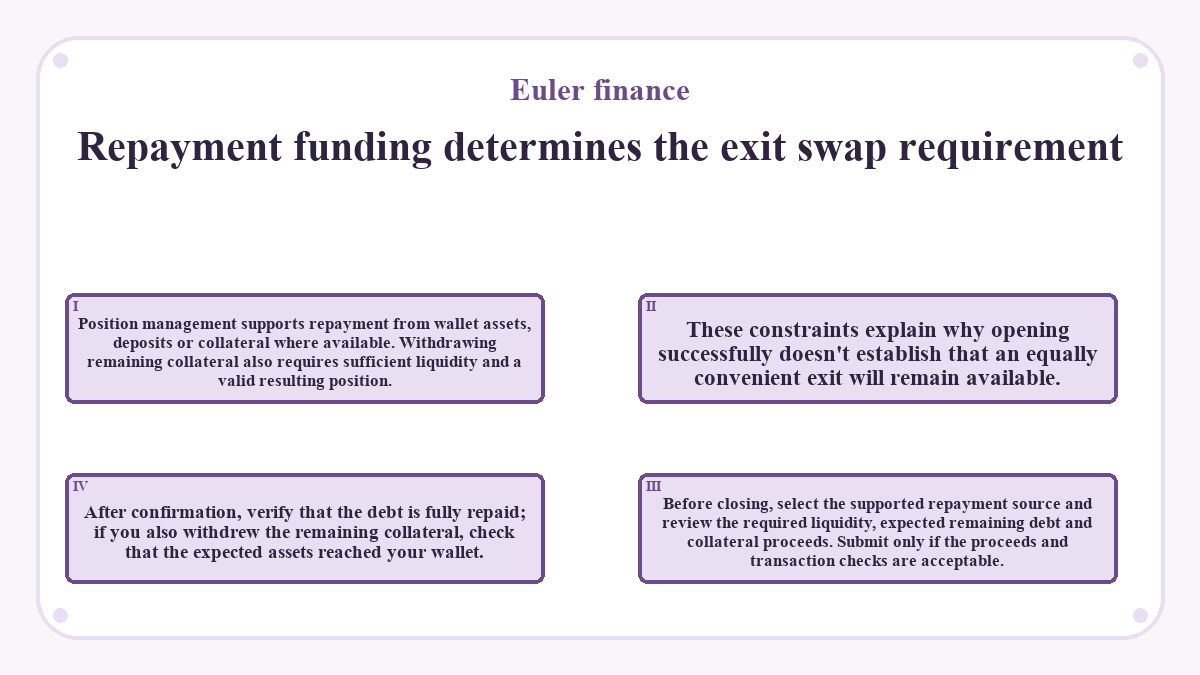
Position management supports repayment from wallet assets, deposits or collateral where available. Withdrawing remaining collateral also requires sufficient liquidity and a valid resulting position. These constraints explain why opening successfully doesn't establish that an equally convenient exit will remain available. Before closing, select the supported repayment source and review the required liquidity, expected remaining debt and collateral proceeds. Submit only if the proceeds and transaction checks are acceptable. After confirmation, verify that the debt is fully repaid; if you also withdrew the remaining collateral, check that the expected assets reached your wallet.
Displayed equity and executable proceeds answer different questions
The value displayed for a position doesn't lock in its eventual sale price. Portfolio values collateral and debt, while an unwind requires transactions at obtainable execution prices.
Protocol health checks introduce another valuation purpose: they assess whether collateral sufficiently supports liabilities. Oracle valuations can differ from secondary-market prices. A position can therefore have acceptable collateral coverage while offering an expensive exit. Conversely, limited liquidity can complicate an unwind without independently determining liquidation eligibility. These distinctions keep a trading quote from being mistaken for a health assessment.
Holding time changes how much execution costs matter
Entry and exit costs occur around transactions, while lending income and borrowing costs accrue over time. Frequent changes or a short holding period leave less time for any favorable rate difference to offset execution costs.
Displayed return on equity applies rate contributions to position equity. Its components can include lending, borrowing, eligible rewards and intrinsic yield. Comparing estimates requires consistent valuation and comparable included components. A positive figure doesn't settle the total outcome when swaps, gas or liquidation losses sit outside that estimate.
A position-size decision therefore needs an affordable entry and a plausible repayment path. If the intended unwind produces insufficient proceeds, reducing the proposed exposure changes the trade under consideration; a more attractive displayed return doesn't repair that exit quote.
Euler finance: the short answers
Does every wallet prompt in a Multiply flow open the position?
An approval or permit prompt can authorize token spending without opening the Multiply position. Euler can batch compatible position actions into one atomic transaction, while authorization may require a separate prompt. The distinction matters when counting transactions and their costs: an authorization alone doesn't demonstrate that borrowing and the collateral exchange have executed.
Can a Multiply increase fail while the position remains below liquidation LTV?
A Multiply increase can fail because the proposed position exceeds its borrowing limit even when the existing position isn't liquidatable. Borrowing permission and liquidation eligibility use different checks. An account-liquidity error can identify this problem; changing slippage tolerance won't correct an action that fails the account's collateral requirements.
Is Max ROE evidence that a Multiply quote will execute?
Max ROE doesn't establish that the modeled position size can be opened or maintained. It applies rate assumptions to a modeled maximum multiplier. Execution still needs a supported route, adequate liquidity and a valid resulting position. Treat the figure as a rate calculation rather than confirmation that the required swap is available.
Which details help diagnose a failed Multiply swap?
The transaction status, exact error and simulation result help distinguish an execution failure from a failed submission. Relevant context includes the selected network, position account, vaults and intended amount. If a transaction hash exists, its status matters before another submission. Diagnostic records should exclude seed phrases, private keys and other signing secrets.